SDS Seminar Series – Sanjay Shakkottai, University of Texas at Austin
Oct
30
2026
Oct
30
2026
Description
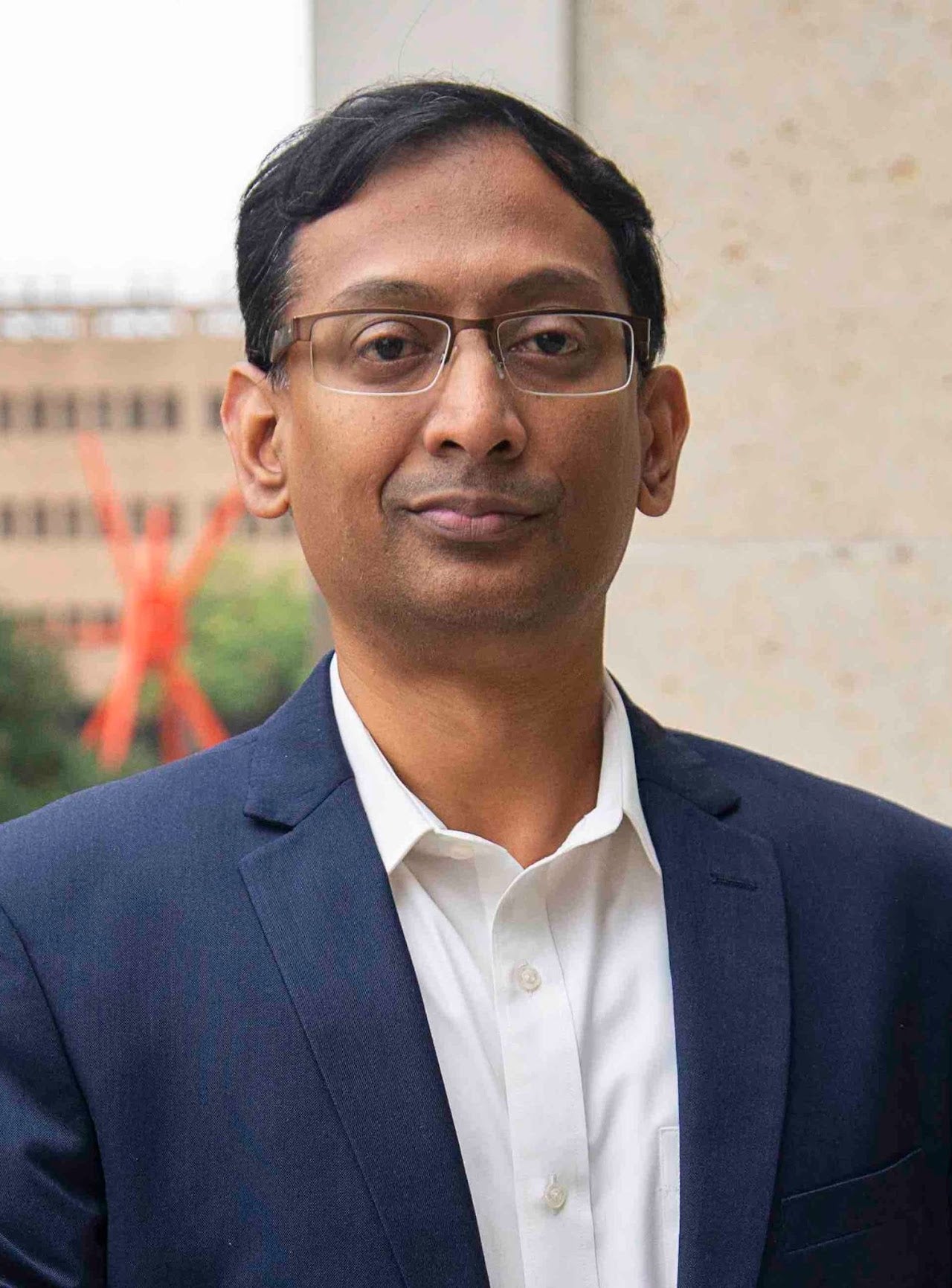
The Fall 2026 SDS Seminar Series continues on October 30th from 2:00 p.m. to 3:00 p.m. with Sanjay Shakkottai Professor, Department of Electrical and Computer Engineering, The University of Texas at Austin. at Austin). This event is in-person in the Avaya Room (POB 2.302).
Bio: Sanjay Shakkottai received his Ph.D. from the ECE Department at the University of Illinois at Urbana-Champaign in 2002. He is with The University of Texas at Austin, where he is a Professor in the ECE and CS Departments, and holds the Cockrell Family Chair in Engineering #15. He is also the Director of the Center for Generative AI, which hosts a campus-wide computing cluster at UT Austin. He received the NSF CAREER award in 2004 and was elected as an IEEE Fellow in 2014. He was a co-recipient of the IEEE Communications Society William R. Bennett Prize in 2021. He has served as the Editor in Chief of IEEE/ACM Transactions on Networking. His current research interests are in diffusion models and Generative AI, with applications in language models, image editing, and decision-making in wireless networks. He has also consulted and collaborated with Google Research and DeepMind on diffusion and flow algorithms for the imaging pipeline (productionized on Google platforms like Pixel and YouTube).
Title: Test-Time Anchoring for Discrete Diffusion Posterior Sampling
Abstract: Discrete diffusion models offer one generative framework for text, images, and biological sequences, with fast parallel decoding and fine-grained control. That makes them well suited to reward guidance, namely, steering a pre-trained model toward outputs that fit a measurement or maximize a reward (without retraining). Continuous diffusion models do this by following reward gradients, but discrete models output tokens, and we cannot differentiate through a hard sample, hence we must construct a surrogate for the reward gradient. In this talk, we first present Anchored Posterior Sampling (APS), which combines quantized expectation for gradient-like guidance in embedding space with anchored remasking for adaptive decoding. APS achieves state-of-the-art results on image inverse problems, stylization, editing, and question answering. We then present EntRGi (Entropy-aware Reward Guidance), which uses predictive entropy to blend soft and hard tokens for reward-guided diffusion language models. Finally, APEX adapts these ideas to protein design under a fixed mutation budget. Based on joint work with Litu Rout, Andreas Lugmayr, Yasamin Jafarian, Srivatsan Varadharajan, Constantine Caramanis, Ira Kemelmacher-Shlizerman, Atula Tejaswi, Sujay Sanghavi, Chi Zhang, Maria Rosaria Briglia, Jeffrey Ouyang-Zhang, Iacopo Masi, Jessie Zhang, Adam Klivans, and Daniel Diaz.
Other Events in This Series
Nov
13
2026
SDS Seminar Series – Arian Maleki, Columbia University
Accurate and efficient data point removal for high-dimensional settings
2:00 pm – 3:00 pm • In Person
Speaker(s): Arian Maleki